
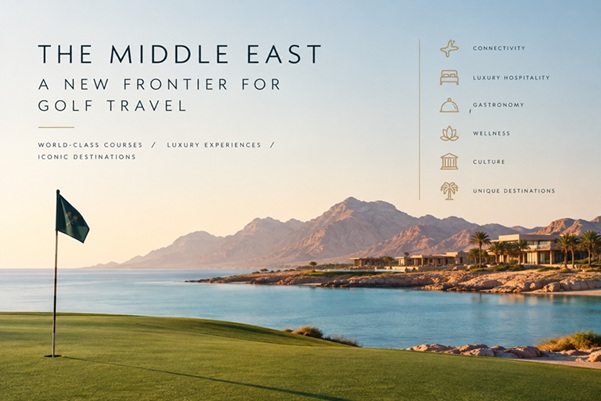
The Middle East is becoming one of the most closely watched regions in global golf tourism.
For decades, destinations such as Scotland, Spain, Portugal, Ireland and the United States dominated the international golf travel conversation. Today, a new generation of destinations is challenging that established geography.
Dubai, Abu Dhabi, Saudi Arabia, Qatar and Oman are increasingly presenting golf as part of a much larger luxury travel proposition.
The appeal is not based solely on golf.
It is based on the combination of world-class hospitality, international connectivity, luxury resorts, gastronomy, wellness, culture and increasingly ambitious destination development.
Dubai: from golf destination to golf ecosystem
Dubai is already one of the most established golf destinations in the region.
The city offers a combination that few destinations can match: major international air connectivity, luxury hotels, high-end restaurants, shopping, entertainment and a growing portfolio of championship golf courses.
Dubai’s golf landscape includes established names such as Emirates Golf Club, Dubai Creek Golf & Yacht Club, Jumeirah Golf Estates, Dubai Hills Golf Club and The Els Club.
According to recent reporting by Golf Digest, the wider Dubai area is now home to around 20 golf courses.
The city’s proposition is particularly attractive for international travellers because golf can easily be incorporated into a wider itinerary.
A visitor can combine several rounds with a luxury hotel stay, private shopping, fine dining, a yacht charter or a short extension elsewhere in the Gulf.
Golf therefore becomes one component of a broader luxury journey.
Saudi Arabia’s ambition is different
Saudi Arabia is approaching golf on a much larger scale.
Golf is being integrated into the Kingdom’s wider transformation of tourism, sport and destination development under Vision 2030.
Golf Saudi and the Public Investment Fund are developing a portfolio of new courses connected to some of the country’s most ambitious tourism and giga-projects.
In 2025, PIF and Golf Saudi announced Future Fairways, showcasing three flagship projects: Shura Links at The Red Sea, Laheq Golf Course on the Red Sea coast and Trojena Northern Golf Course in NEOM.
According to PIF, the number of golf courses in Saudi Arabia is expected to more than triple by 2030.
This is significant because the strategy is not simply about building golf courses.
The objective is to create destinations.
Shura Links: golf on the Red Sea
One of the most visible examples is Shura Links.
Opened in September 2025, the course became Saudi Arabia’s first 18-hole golf course located entirely on an island.
Situated on Shura Island at The Red Sea destination, the par-72, 7,400-yard course runs through mangroves and dunes before reaching the Red Sea coastline.
The project illustrates the direction of Saudi luxury tourism.
Golf is being combined with high-end resorts, wellness, nature, architecture and coastal experiences.
The golfer is therefore not simply buying a tee time.
The golfer is buying access to a destination.
Qiddiya and the future of golf in Riyadh
Another important development is taking shape near Riyadh.
Qiddiya City is developing an 18-hole championship golf course designed by Sir Nick Faldo, set against the dramatic landscape of the Tuwaiq Mountains.
The project is designed to include a clubhouse, academy, practice facilities, wellness amenities and dining.
The concept reflects a broader change in golf development.
Modern golf destinations increasingly need to serve different types of visitors: experienced golfers, beginners, families, young players and non-golfing companions.
This makes the clubhouse and surrounding hospitality offer almost as important as the course itself.
Why the Middle East has a natural advantage
The region benefits from several structural advantages.
First is connectivity.
Dubai, Doha and Abu Dhabi already function as major international aviation hubs connecting Europe, Asia, Africa and the Americas.
Second is hospitality.
The Gulf has developed one of the world’s strongest luxury hotel markets, giving golf destinations access to sophisticated accommodation and service infrastructure.
Third is investment.
Large-scale destination projects allow golf to be developed alongside hotels, residences, marinas, entertainment venues, wellness facilities and cultural attractions.
Fourth is climate.
During the European winter, destinations across the Gulf can offer attractive conditions for golf travel, creating opportunities for seasonal demand.
Golf as a tourism diversification tool
For governments and tourism authorities, golf also has a strategic value.
Golf travellers are generally attractive visitors because golf holidays can involve accommodation, green fees, transportation, dining, leisure activities and longer stays.
Golf Saudi explicitly identifies international golfers as an important tourism audience and is using the sport to support the Kingdom’s wider tourism proposition.
This is particularly relevant as Saudi Arabia develops destinations such as The Red Sea, AlUla, Diriyah, NEOM and Qiddiya.
Golf can help connect these destinations to international premium travel markets.
The next generation of Middle East golf
The Middle East is unlikely to replace traditional golf destinations.
Instead, it is creating an additional category.
The region’s proposition is less about traditional golf heritage and more about combining the sport with new luxury experiences.
A traveller may play golf overlooking the Red Sea, spend the evening at a luxury resort, explore Saudi heritage the following day and continue the journey to Riyadh or another Gulf destination.
This is precisely where golf tourism meets modern luxury travel.
The Middle East is not simply building golf courses.
It is building reasons to travel.
And as the global golf audience continues to expand, the region is positioning itself to capture a growing share of the next generation of international golf travellers.


