
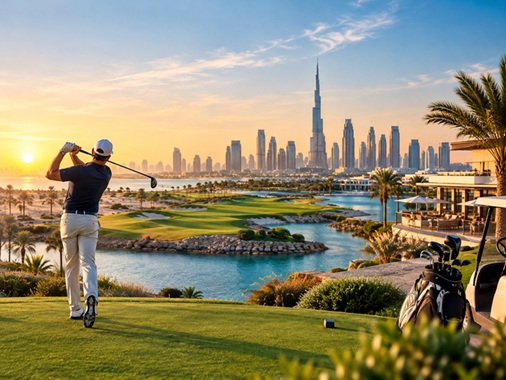
Golf tourism is entering a new phase of international growth.
Once considered a relatively specialised segment of the travel industry, golf tourism is increasingly becoming part of the broader luxury travel economy. Golfers are no longer travelling simply to play a course. They are travelling for destinations, hospitality, wellness, gastronomy, culture and experiences built around the game.
The numbers underline the scale of the opportunity.
According to The R&A’s 2024 Global Participation Report, 108 million adults and juniors were playing golf across the organisation’s affiliated markets in 2024, covering Europe, Asia, the Middle East, Africa, Canada, Latin America, the Caribbean and Oceania, but excluding the United States and Mexico.
Of this total, 43.3 million people were playing traditional nine- or 18-hole golf, while the remainder were engaging with alternative formats including driving ranges, indoor golf, adventure golf and other forms of participation.
For the travel industry, this expanding global audience represents a significant pool of potential travellers.
From golf holiday to complete travel experience
The traditional golf holiday was relatively straightforward: book a destination, play several courses and return home.
Today’s golf traveller increasingly expects more.
A golf trip may now combine championship courses with a luxury resort, fine dining, spa treatments, local culture, sightseeing, private transfers and experiences for non-golfing companions.
This evolution is particularly relevant to luxury travel.
For affluent travellers, the golf course is often the starting point rather than the entire experience. A destination must offer reasons to stay longer and to return.
This is changing the way resorts and tourism boards position themselves.
The question is no longer simply whether a destination has good golf.
It is whether the destination can create a compelling lifestyle around golf.
A powerful international business ecosystem
The professional infrastructure behind golf tourism is also becoming increasingly sophisticated.
The International Association of Golf Tour Operators, IAGTO, currently brings together more than 2,600 member companies across 93 countries, including hundreds of specialist golf tour operators.
According to IAGTO, its specialist operators are responsible for more than 90% of golf holiday packages sold worldwide and generate more than €2.5 billion in annual turnover.
This illustrates how golf tourism has evolved into a significant international B2B market connecting destinations, hotels, resorts, golf courses, airlines, tour operators and travel advisers.
Trade events such as IGTM have become important meeting points within this ecosystem, allowing destinations and suppliers to establish relationships with buyers from major outbound markets.
The rise of experiential golf
One of the most important developments is the growing importance of experience.
Golf travellers are increasingly attracted to destinations where the course is integrated into a broader environment.
A round of golf can be followed by a Michelin-level dinner, a spa treatment, a yacht excursion, a cultural visit or a private desert experience.
This trend favours destinations capable of combining several premium travel products.
It also explains the growing appeal of regions such as the Middle East, where golf can be integrated into sophisticated hospitality, aviation, entertainment and luxury tourism ecosystems.
Wellness becomes part of the golf journey
Golf and wellness are increasingly connected.
Golf naturally lends itself to outdoor activity, walking, nature and social interaction. Luxury resorts are now building on these characteristics by adding fitness programmes, nutrition, recovery treatments, spas and wellness facilities.
The result is a new generation of “stay-and-play” experiences where golf becomes part of a broader wellbeing journey.
For resorts, this creates opportunities to attract both golfers and non-golfers travelling together.
For destinations, it can increase the length and value of the visitor stay.
Technology is changing the booking journey
Technology is also transforming golf travel.
Golfers can increasingly research courses, compare resorts, build itineraries and access recommendations digitally before speaking to a travel adviser.
Artificial intelligence, booking platforms, virtual experiences and performance technologies are contributing to a more personalised travel journey.
But technology is not replacing human expertise.
For high-end golf travel, relationships remain essential. Experienced advisers can recommend the right course, the right hotel, the best season and the most appropriate itinerary for a particular traveller.
Luxury golf travel therefore remains a combination of digital convenience and human knowledge.
A global market with new destinations
The geography of golf travel is changing as well.
Traditional destinations such as Spain, Portugal, Scotland and Ireland remain extremely important. The Costa del Sol, for example, was recognised by IAGTO as the Best European Golf Destination in 2025.
At the same time, new destinations are entering the international conversation.
The Middle East is perhaps the most significant example.
Dubai has developed a sophisticated golf ecosystem alongside its luxury hotels, aviation infrastructure and international tourism proposition. Saudi Arabia is investing heavily in golf as part of a much wider strategy to develop tourism and sports.
Oman, Qatar and other destinations are also developing propositions that combine golf with nature, culture and high-end hospitality.
The future is about more than the course
Golf tourism is becoming increasingly aligned with the wider evolution of luxury travel.
Travellers want more personalised experiences, better service, greater flexibility and destinations that offer something beyond the expected.
Golf provides a powerful foundation for this model because it naturally connects sport, travel, hospitality and lifestyle.
The future of golf travel will therefore not simply be measured by the number of rounds played.
It will be measured by the quality of the journey surrounding them.
And for destinations capable of combining exceptional golf with luxury hospitality, culture, wellness and authentic experiences, the opportunity is only beginning.


